Walter Mitty and a Ukrainian Calling.

“An Army of One” was the Army’s recruiting slogan in the early 2000’s. To address its sagging manpower goals, Army marketing research went into reaching the stereotypical male teen, playing video games by himself in the basement all day. The Army concluded the current generation of young people is so individualistic, so resistant to authority and rules, that it has to market military life as the natural home of the free-wheeling unfettered spirit.” A critic saw the base dishonesty in the pitch. “The Army is not, never has been and never will be about one soldier. Individuality has absolutely nothing to do with Army life,” he wrote.  Another commentator remarked, “if you want to be an ‘Army of One’ you probably want to join the Hell’s Angels, not the U.S. Army.”

It’s in that context that thousands have volunteered as free-agent soldiers for Ukraine’s freedom. News reports indicate Ukraine has had little trouble attracting young American men to join in the fight. Under American law, it’s legal for a U.S. citizen to provide combat services as a volunteer – although it is illegal to fight as a compensated foreign mercenary.  The Law of Armed Conflict defines the conditions to needed to recognize a fighter as a legitimate combatant:  (1) they form part of a military command structure, under formal orders and preceded by an “official request”; (2) they display a distinctive badge; (3) they carry arms openly; and, (4) they conform to the rights and obligations of war.

Take for example, a young Ohio man (said to be a rightwing militia member) whose flight was paid by donations through GiveSendGo. (The same Christian funding site was used by “American hero”, Kyle Rittenhouse, who moved on to “make a killing (pun intended) on the evangelical speaking circuit )”. After publicizing his complaints about harsh field conditions, including inadequate supplies of weapons and ammunition, our brave Ohio freedom fighter deserted his post and fled Ukraine. “I have been here 15 days now and still nothing is happening,” another volunteer bitched on a phone interview. “I am not putting up with that.” Perhaps that’s why none of these “armies of one” ever enlisted in the military.

In Jesus and John Wayne, Kristin Du Mez wrote of how Wayne became an icon of evangelical masculinity: “his toughness and his swagger; he protected the weak, and he wouldn’t let anything get in the way of his pursuit of justice and order.” She adds Trump’s “testosterone-fueled masculinity aligned remarkably well with that long championed by conservative evangelicals.” For any number of young evangelical Walter Mittys, the heady battlefield mix of testosterone and adrenaline is the chance to prove their Christian manhood.

But there’s a time when lofty idealism meets grim reality. It’s one thing to rack a high score at the local gun range, or on your Big Game Hunter video game. Or in the woods, shooting at animals that don’t shoot back. It’s quite another when you’re hunkered down in a fetid dirt trench, while 120mm mortar rounds splash all around you. That’s literally the baptism by fire, where even seasoned veterans often lose their nerve – and the contents of their bowels.

A California guy who said he liked “guns, cars, building stuff, basketball, sports and MMA” was eager to get on the battlefield and kill Russians. He had no military experience, but wanted to be a sniper. “They have no experience in doing such a job,” Mamuka Mamulashvili, commander of the Georgian National Legion said. He added that war tourists were an unwelcome – if not dangerous – nuisance. “You are not Rambo, there to single-handedly slay Russians and post your selfies,” a former CIA operative cautioned. His advice was basically: grow up, shut up, and do what you’re told. Just the sort of thing that millenials didn’t want to hear from their parents, either.

Its interesting to note that the chance of seeing combat in the army is low. Only 10% are deployed into front line combat. The remainder are assigned to supporting units: administration, maintenance, logistics, medical, military police, chow hall, etc. Many of these soldiers are doing non-sexy jobs like supervising cargo deliveries or guarding critical infrastructure. That’s the lowered expectations that a Michigan male went in with. A veteran with a 50 year-old back has given up on the idea of slogging through mud with an overweight pack. “I’m a realist,” he says, comparing his physical condition to his service days in the 1980’s. “He suggested that he might drive a truck to transport refugees or bring food into areas of need,” the article comments.

Well, these skills aren’t exactly exclusive to the military. During my years in Sarajevo, people would tell me stories of Serb forces allowing European trophy-hunters to zero in on Sniper Alley. Humans are the ultimate big-game. It nauseates me to think of volunteer killers. It seems odd that so many volunteers drop their teddy out of the crib and go home if they can’t kill someone. If they have to drive an army truck to support the Ukrainian military, that’s not on their adventure bucket list.

In fact, why must it be a military truck? Why not use that plane ticket and fly to someplace in eastern Poland, and volunteer with a civilian refugee aid organization?  Flights from the U.S. to Warsaw are still under $1000. If young Christian men want to serve Ukraine, that’s what I’d recommend.
Daily Prayer For Ukraine

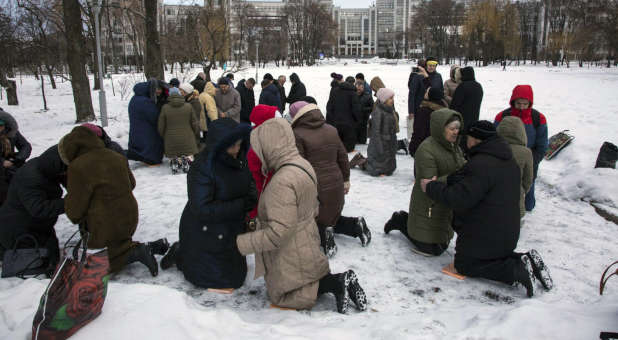
A group of Ukrainians meeting each morning to pray (International Missions Board)

God of Mercy, for whom no one is beyond the limits of Your love,

May we seek your peace.

We pray for Ukraine.

For the church witnessing in Ukraine and all those who call on your Name,

For refugees and those uprooted from their homes and lives,

For soldiers exposed to danger and civilians who dwell in fear,

For those without food, water or medicines,

For those who have witnessed death and destruction on their streets,

For those who have experienced the loss of a loved one,

For those separated from parents, from children, from spouses and siblings,

For all those providing comfort and shelter,

For those having the power over life and death; that they will choose for all people life,

For the wounded, the dying, and the captive, that you would bring healing of body and soul,

For medical workers ensuring that shattered bodies are put back together again,

For ordinary Russians, that they turn swords into ploughshares and seek for peace,

For world leaders; especially those enabling Ukrainians to have safe passage,

For President Putin and those who choose war; that they instead seek the Lord with all their hearts.

For ourselves, that the Holy Spirit grant us the will to turn our prayers into example, and that we become doers of the Word also.

In the name of Jesus Christ, we pray./ В ім’я Ісуса Христа ми молимося.

Amen

Russian Mothers versus The Cargo of Death

Mama I didn’t want to come.” A captured conscript was shown on Ukrainian media, getting his message out by the only mean available.  Russian authorities had imposed a total blackout of news from the front – pretending there were no casualties or POWs. Ukrainian estimates hover around 5300 so far, although the Russians simply declare their losses were “many times” less than those of the Ukrainians. As the fighting continues, there are many more Russian dead.  Many of these are youngsters from rural villages and were tricked into fighting; some didn’t even know they were in Ukraine. Troops are disoriented, hungry, and don’t understand why they’re invading.

The current conflict is a tragedy for both combatants. Let’s focus on the Russian side for a moment. Starting at age 18, Russian young men are obliged to 12 months military service. Many are draft-dodging; hiding out for fear of being press-ganged, or even seeking asylum in the U.S.  Conscripts live under squalid conditions, made even more degrading by the informal hazing process called Dedovshchina, frequently involving rape, beatings, and extorting money. The Russian conscript’s status as throwaway doesn’t even terminate with his death.

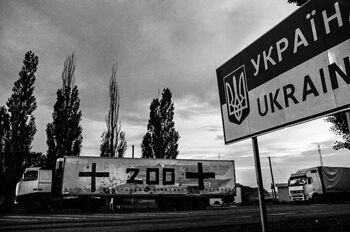
The Afghan war left some 13,000 bereaved families – although official Russian figures were “significantly  undercounted”. In a process officially designated Cargo 200, the “lucky” dead were known as “Zinkies”, because they were repatriated in sealed zinc caskets. As the Cargo 200 death train chugged along, it often came to an end in a dirty warehouse, with grieving parents traveling to retrieve their son and bury him at own expense. This was not the America that receives fallen soldiers with full military honors. They meant nothing more to the USSR than cannon fodder. A few relatives had the nerve to pry the coffin open, only to find rocks and sand.  In 2014, Russian troops in unmarked olive-drab uniforms masqueraded as “Little Green Men”, seizing all of Crimea. If captured, soldiers were ordered to say they had come as random volunteers during their “vacations”.  Bodies were returned, but were met with a cover-up of the funerals by Russia’s state-controlled media. The remains were disbursed throughout cemeteries to disguise the numbers. Gravestones were unmarked, and mourners were told not to ask questions.

There is some doubt whether Cargo 200 will resume operations in Ukraine. Reports indicate Russia has deployed mobile crematoria to incinerate dead soldiers in-situ to hide the true scale of Ukraine war. “We’ve had a flurry of calls from scared mothers all over Russia. They are crying, they don’t know if their children are alive or healthy,” according to the Committee of Soldiers’ Mothers. The Committee is a well-respected NGO within Russia. Since the 1980’s, it has “played a crucial role in opening up the military to public scrutiny and in influencing public perceptions of military service.”.”  Many demoralized Russian conscripts in Ukraine have pleaded with their mothers to bring them home.

I wish I had met my wife’s uncle Gisbert. But he lies somewhere in a mass grave. Barely 17, he was drafted into the last-ditch Wehrmacht and was killed almost immediately on the Eastern Front. When a soldier dies, its the women left behind who suffer the most. Cremation is forbidden in the Orthodox canon, and those vehicle-mounted crematoria will not replace the all-important rite of consecrated funerals. It is a sin to deny a holy burial for a body violently torn from its soul, let alone allow the grieving family closure under the Church. If internal discontent is simmering in Russia, it is mothers having lost their sons to another pointless war that will raise the temperature.

Walk into any Russian Orthodox church and you’ll see the majority are mothers and grandmothers. Despite the repression of religion during Soviet times, it was these matroskas and babushkas that “refused to allow the flame of faith to go out in Russia”.  Being a babushka in Russia equates to something just short of gaining sainthood. Solzhenitsyn, the keen observer of the minutia in everyday Russian life, evokes the moral superiority of that guardian of the Russian soul, the peasant mother. He writes of his saintly peasant Matryona, as a sacred icon: “the righteous one, without whom, as the proverb says, no village can stand. Nor any city. Nor our whole land.”  Joanna Hubbs adds that Solzhenitsyn “evoked the moral superiority of that guardian of the Russian soul, the peasant mother.”[i] Mothers and grandmothers are the foundation of Orthodox spiritual life, and the preparation for death is at its center. Putin is desecrating the sanctity and memory of these dead. Putin should never underestimate the moral power of a Russian mother.

We are entering the spiritual season when we set our faces towards the Cross, and the Son of Man who suffered many things, even unto death. This Lent, we should pray the spirit of Cargo 200 be rebuked, and take up our cross with those who are suffering, both in Ukraine AND Russia. Especially the women who can’t properly bury the “throw-aways” and are left behind to grieve. Pray for the mothers of sons they’ll never see again. !


[i]   Joanna Hubbs, Mother Russia, (Bloomington: Indiana Univ. Press), 1993, p. 237